A status page publicly (or privately) communicates the real-time health of your service — uptime, incidents and scheduled maintenance — so customers and internal teams stop flooding support the moment something breaks. Below we compare the nine best status page tools of 2026 by price, features and free-plan limits.
Quick comparison
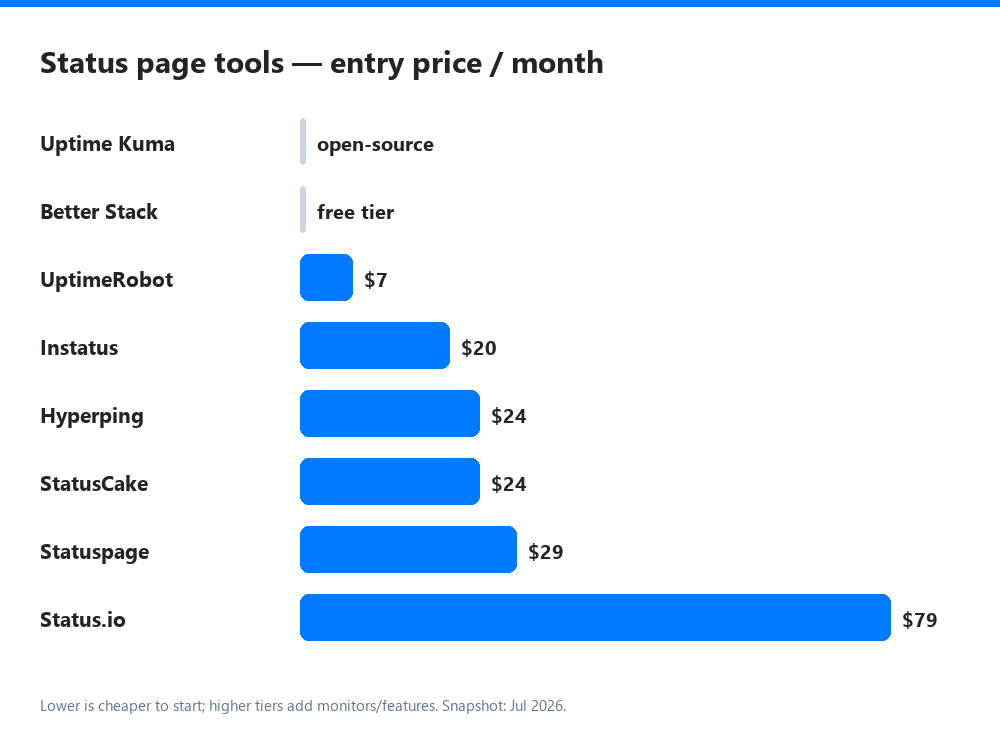
| Tool | Free plan | Paid from | Best for | Monitoring built in? |
|---|---|---|---|---|
| Better Stack | ✅ (custom domain) | usage-based | All-in-one on a budget | ✅ |
| Instatus | ✅ (unlimited subs) | ~$20/mo | Best-looking, fastest pages | ✅ |
| Atlassian Statuspage | ✅ (no custom domain) | $29/mo | Enterprise & integrations | ❌ |
| Hyperping | Trial | $24/mo | Flat-rate monitoring + status + on-call | ✅ |
| Status.io | ❌ | $79/mo | Advanced/enterprise comms | ❌ |
| UptimeRobot | ✅ (non-commercial) | $7/mo | Existing UptimeRobot users | ✅ |
| StatusCake | ✅ | ~$24/mo | Uptime + status page combo | ✅ |
| Uptime Kuma | ✅ (self-host) | Free (OSS) | Self-hosted / zero cost | ✅ |
| Openstatus | ✅ (OSS) | Cloud plans | Compliance-first, open-source | ✅ |
Pricing is a July 2026 snapshot and changes often — confirm on each vendor’s plan page before buying.
The 9 best status page tools
1. Better Stack — best all-in-one for the price
Better Stack rolls status pages, uptime monitoring, on-call and incident management into one modern platform. Its standout is a completely free hosted status page — with a custom domain and branding, which most competitors charge for. Paid scaling is usage-based (roughly $29/user/mo, $21 per 50 monitors, $12 per status page), so costs can climb as you add seats and monitors.
- Best for: teams that want a status page and the monitoring behind it without paying up front.
- Watch out for: usage-based add-ons make large setups less predictable than flat-rate rivals.
2. Instatus — best-looking and fastest
Instatus builds status pages on a Jamstack architecture that loads up to 10× faster than Statuspage.io, which matters because your status page has to stay up when everything else is down. The free plan is unusually generous (unlimited subscribers and teammates); Pro (~$20/mo) adds 50 monitors, 30-second checks, custom domain, SMS alerts and up to 5,000 subscribers. Business starts around $300/mo.
- Best for: brands that want a polished, fast, on-brand status page cheaply.
3. Atlassian Statuspage — the enterprise incumbent
The category’s best-known name, tightly integrated with Jira, Opsgenie and the Atlassian ecosystem. It’s powerful but the priciest here: Hobby $29/mo (limited), scaling to Business $399/mo and Enterprise $1,499/mo. The free tier notably can’t use a custom domain.
- Best for: enterprises already living in Atlassian tooling.
- Watch out for: cost and complexity for small teams.
4. Hyperping — best predictable flat rate
Hyperping bundles monitoring, status pages and on-call scheduling at flat rates with no usage surprises: Essentials $24/mo (50 monitors, custom domain, on-call), Pro $74/mo (100 monitors, voice alerts), Business $249/mo (1,000 monitors, SAML SSO, 20-second checks).
- Best for: teams that want one predictable bill for monitoring + status + on-call.
5. Status.io — advanced incident communications
Aimed at organizations with complex, multi-audience communication needs (private/public pages, granular subscriber controls). Starts at $79/mo up to $999/mo; no free plan.
- Best for: larger orgs with sophisticated incident-comms workflows.
6. UptimeRobot — best if you already monitor here
If you already use UptimeRobot for uptime, its built-in status pages are the path of least resistance. The free plan includes a basic status page (but is non-commercial only since late 2024); paid plans start at $7/mo (Solo).
- Best for: existing UptimeRobot users wanting a quick status page.
- Related: UptimeRobot vs Pingdom
7. StatusCake — solid uptime + status combo
A well-established uptime monitoring service with capable status pages bundled in. Reasonable mid-market pricing (paid from ~$24/mo) and a usable free tier.
- Best for: teams wanting monitoring and a status page from one affordable vendor.
8. Uptime Kuma — best free & open-source
A self-hosted, MIT-licensed favorite. Completely free if you run it yourself, with a clean UI, monitoring and a built-in status page. You trade a monthly bill for hosting and maintenance.
- Best for: homelabs, startups and anyone who wants zero recurring cost.
9. Openstatus — open-source, compliance-first
A newer open-source option positioning around transparency and compliance, with both self-hosted and cloud plans.
- Best for: open-source-first teams that also need synthetic checks.
How to choose the right status page tool
- Want it free? Better Stack (hosted) or Uptime Kuma (self-hosted).
- Care most about looks and speed? Instatus.
- Need one predictable bill for monitoring + status + on-call? Hyperping.
- Live in Atlassian / need enterprise integrations? Statuspage.
- Already monitoring somewhere? Use that vendor’s built-in status page (UptimeRobot, StatusCake) before adding a tool.
Two features worth prioritizing: independent hosting (your status page must survive your own outage) and subscriber notifications (email/SMS/Slack/webhook) so customers hear it from you first.